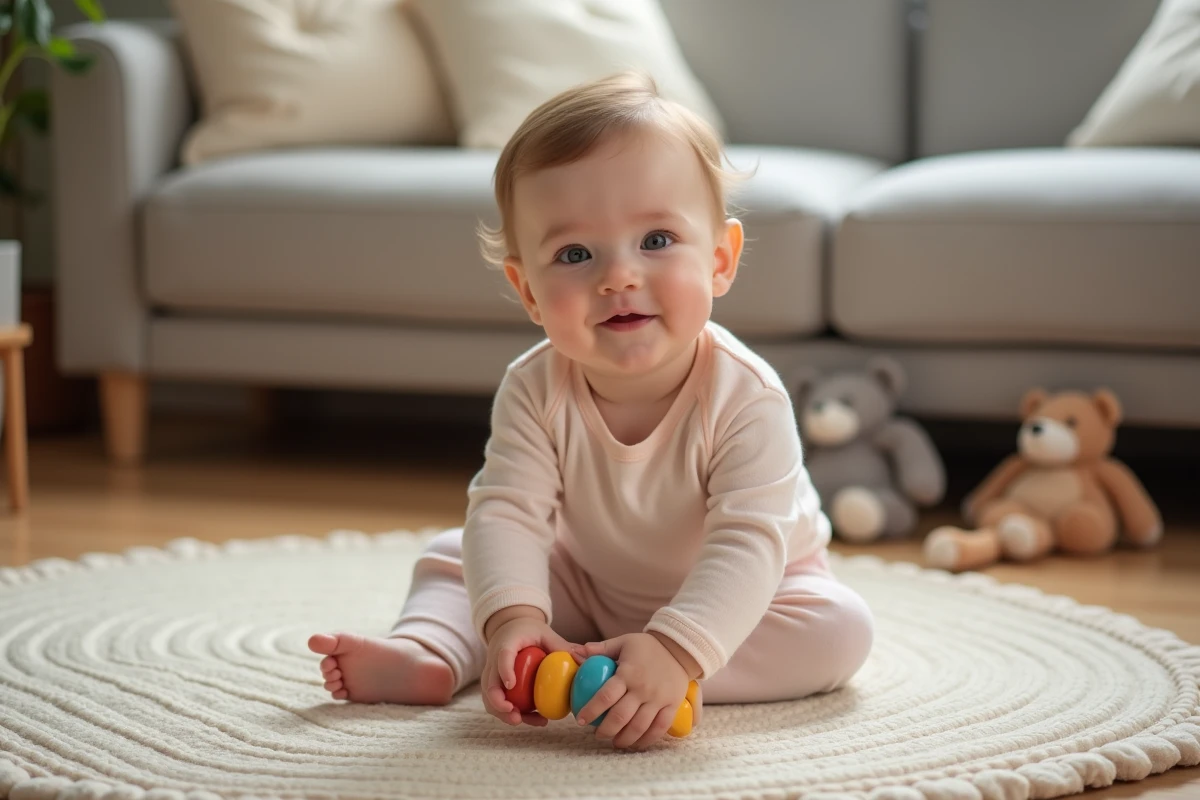
A newborn does not distinguish all colors at birth, but perceives contrasts very early on, fostering the development of vision and attention. Before learning to walk, a baby works on their balance through multiple micro-movements, invisible to the naked eye but essential for acquiring gross motor skills. A too rigid routine can sometimes hinder natural curiosity and adaptability, contrary to what some manuals suggest.
The stages of development vary greatly from one child to another, without indicating a delay or concerning advancement. Some simple activities, often underestimated, play a central role in daily awakening and flourishing.
The major stages of baby development: from birth to 12 months
Over the first months, baby development follows its own pace. Each progress, whether it is an innate reflex, a more precise movement, or sensory exploration, marks a discreet but crucial victory. From the first days, the infant turns their head towards the light, reacts to the slightest noise, and grasps a finger that approaches. Sensory development precedes voluntary gestures, laying the groundwork for coordination between the eye and hand, and then for motor autonomy. The gestures become less random: grasping a rattle, following a face, discovering their own hands… all these steps already build self-confidence.
Experts emphasize the importance of allowing each child to progress at their own pace. Free motor skills, highlighted by Emmi Pikler and then by Michèle Forestier, involves not forcing the child to adopt postures or movements for which they are not ready. One does not prop a baby up to sit if they do not settle themselves, nor do we push them to walk earlier. This approach grants the child the right to experiment, to fall, to try again, and nurtures their assurance. The Montessori pedagogy shares this vision of a supportive accompaniment, where the adult is not an authoritarian guide but a discreet partner.
During the first year, feeding evolves rapidly. Breast milk or infant formula covers almost all needs, while the intake of vitamin D supports bone growth. Around six months, the child gradually discovers new foods: vegetable purees, fruits, new textures. This diversification is not just a matter of nutrition; it opens the door to curiosity and the discovery of taste. For comprehensive resources and advice for young parents, the site happymaman.fr for baby offers step-by-step support to calmly follow your child’s development.
How to stimulate awakening daily without pressure?
No need to fill the house with noisy gadgets or multicolored objects. A safe environment, designed with simplicity, is often enough to awaken the child’s curiosity. An uncluttered space, a few well-chosen toys, a soothing light: these elements invite the child to embark on a journey of exploration at their own pace, without any competition.
The routine structures the days of the little one. Reproducing certain rituals and establishing stable markers allows the child to feel secure and better understand their surroundings. Setting aside moments for awakening, play, songs, readings, while respecting breaks and the need for calm, creates a beneficial balance. Parents play a key role here. Silent observation, physical contact, whether through carrying, massage, or a simple hug, strengthens this fundamental bond. These interactions nourish emotional security, a true driver of overall development.
Here are some guidelines for accompanying baby without ever constraining them:
- Let the child try new positions, manipulate various objects, and listen to a familiar voice.
- Encourage their discoveries without trying to speed up the process: a kind word, discreet attention, a reassuring presence makes all the difference.
- Think about adapting the environment according to the baby’s age: a reading corner, a selection of rattles, a mirror wisely placed on the floor.
Play should remain a shared pleasure, not a race for performance. Curiosity is born and grows in listening, trust, and the freedom to try, fail, and try again. It is in this simplicity that the child finds the joy of exploration.

Fun activity ideas to strengthen the bond and encourage curiosity
Baby development is enriched by everyday actions, gentle gestures, and moments shared in simplicity. From the first weeks, it is possible to offer sensory games suited to the child’s age: a play mat with various materials, a few light rattles, black and white mobiles hanging above the crib. These objects sharpen sight, hearing, and touch, without ever boring or overwhelming.
An unbreakable mirror placed on the floor gives the child the opportunity to discover themselves, observe their reflection, and become aware of their body movements. Handling soft cubes, a light ball, or a teething toy encourages hand-eye coordination. Small awakening workshops at home, manipulating a wooden spoon, listening to a piece of soft music, flipping through a board book, help strengthen attachment and develop the child’s natural curiosity.
Here are some concrete ideas to vary discoveries over the days:
- Compose a basket of everyday objects (wooden spoon, colorful fabrics, teething ring) to allow baby to explore different materials and shapes.
- Provide books with thick, illustrated pages that are easy to handle, to awaken interest in language.
- Draw inspiration from the Montessori method by letting the child freely choose their activity, thus encouraging autonomy and initiative.
The real secret? A safe and calming environment, where each experience transforms into a shared adventure, full of surprises and emotions. Awakening is invented every day, far from ready-made recipes, in the flow of glances, laughter, and first discoveries.