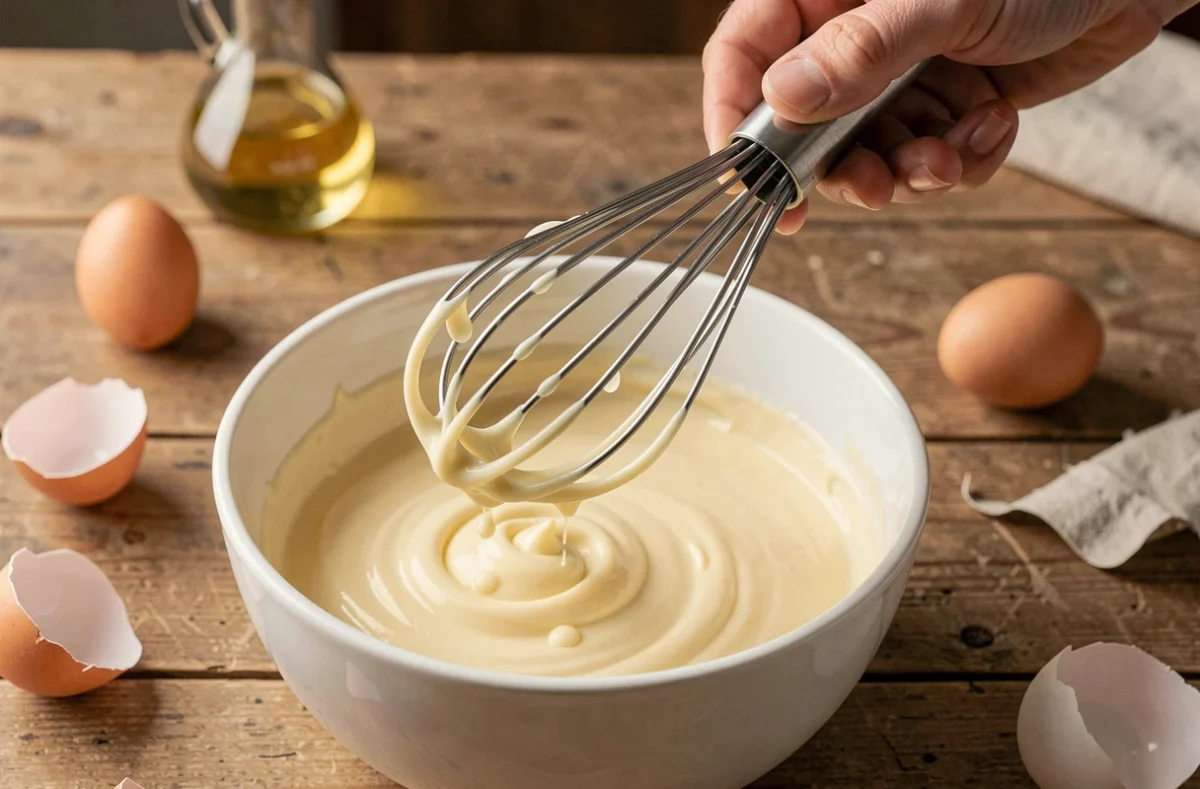
Whisking mayonnaise transforms an egg yolk and oil into a thick, stable cream. The result depends as much on the technique as on the tool in hand. Not all whisks create the same emulsion, and a poor choice can make the task tiring or even doomed to failure.
Emulsion and whisk: why the shape of the wires makes all the difference in mayonnaise
Have you ever noticed that some whisks tire your wrist without thickening the sauce? The problem often lies in the geometry of the wires. For mayonnaise to set, the oil must be dispersed into microscopic droplets within the egg yolk. The more air the whisk traps and the more it cuts through the fat, the faster the emulsion forms.
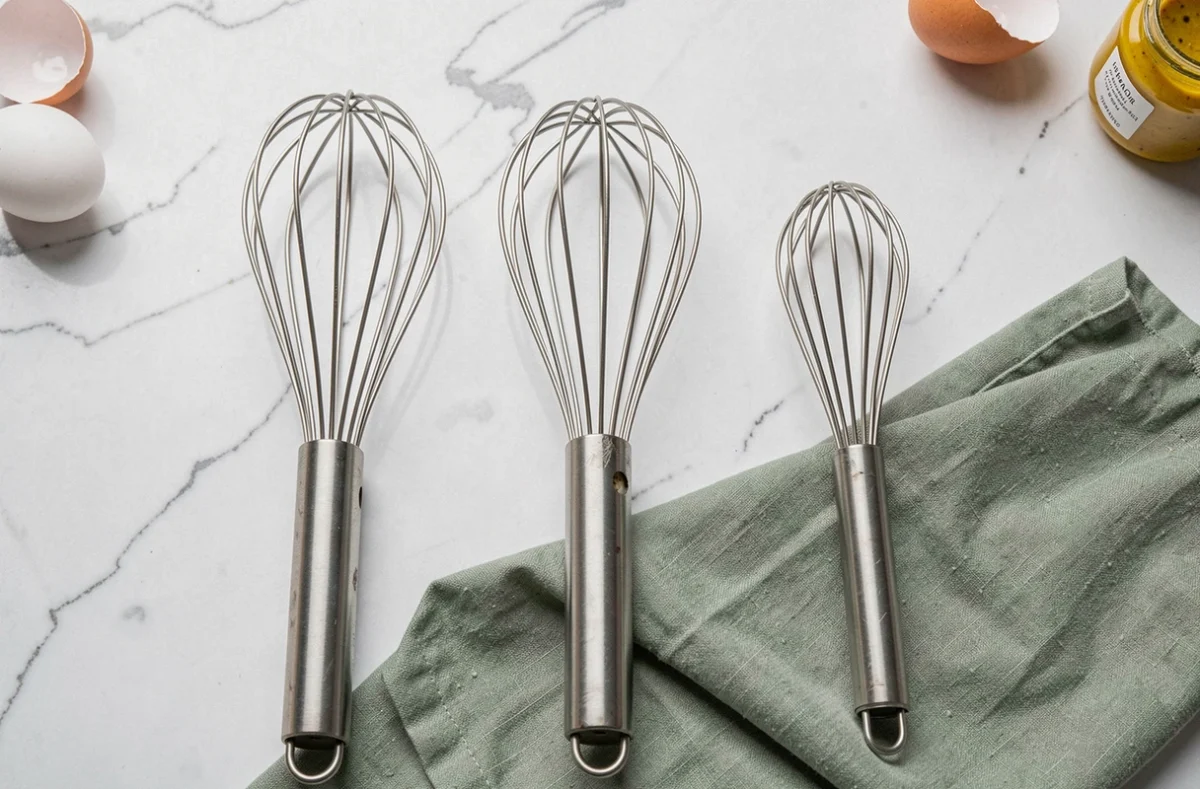
A balloon whisk with wide, rounded wires fulfills this role perfectly. Its curved shape incorporates a significant volume of air with each movement. The spaced wires multiply the points of contact with the oil, which speeds up dispersion.
In contrast, a flat whisk or a sauce whisk, designed for deglazing a pan or smoothing a béchamel, works on an almost horizontal plane. It mixes but does not create the whirlpool necessary for emulsion. The result: the oil remains pooled instead of breaking up, and the mayonnaise does not thicken. If you’re looking to find out which device or whisk for homemade mayonnaise is best, the short answer is one word: balloon.
Stainless steel, silicone, or nylon whisk: which material for making mayonnaise
The material of the wires is not just a question of durability. It directly influences the stiffness and thus the force transmitted to the preparation.
- Stainless steel: this is the standard in professional kitchens. The rigid wires transmit all the energy from the wrist to the sauce. Stainless steel resists the acidity of lemon or vinegar without deteriorating. For mayonnaise, it is the most effective choice.
- Silicone: the silicone-coated wires protect non-stick containers. They are more flexible, which cushions the movement. The mayonnaise thickens, but it takes longer to whisk. This compromise is justified if you are working in a ceramic bowl or a fragile mixing bowl.
- Nylon: lightweight and inexpensive, it is suitable for mixing already fluid preparations. For a thick emulsion like mayonnaise, nylon lacks firmness and makes the task laborious.
A stainless steel balloon whisk remains the most suitable for whisking mayonnaise by hand. If your bowl is prone to scratches, silicone will do the job with a bit of patience.
Whisk and bowl size: the duo that prevents failed mayonnaise
A whisk that is too small in a bowl that is too large disperses the movement. The oil spreads instead of concentrating around the wires. For mayonnaise (one yolk, a few tablespoons of mustard), a whisk of about 25 cm and a narrow, tall bowl form the most effective duo.
The tall bowl confines the preparation. Each whisk stroke passes through the entire mass, preventing the oil from staying on the surface. This is actually the same principle used by an immersion blender: a narrow container forces the emulsion to form from the bottom up.
The handle, a detail that matters
Whisking mayonnaise by hand takes several minutes of quick, steady movements. A handle that is too thin or too smooth slips in a slightly greasy hand. Opt for a thick handle, slightly textured or made of non-slip material. A comfortable grip reduces fatigue and allows for a steady rhythm, which is directly related to the success of the emulsion.

Manual whisk or immersion blender: which to choose for homemade mayonnaise
The immersion blender is often presented as a quick alternative to the whisk. It works, but not in the same way. Submerged at the bottom of a tall, narrow container, it creates an almost instant emulsion from the bottom up. The result is denser and less airy than with a balloon whisk.
The texture obtained with a manual whisk is lighter, with small air bubbles incorporated during whisking. It is this texture that distinguishes a “classic homemade” mayonnaise from a blender mayonnaise. Both are successful, but they have different mouthfeels.
The manual whisk has another advantage: control. When the oil is added drop by drop at the beginning, the wrist’s rhythm naturally adapts. With a blender, the rotation speed is fixed, leaving less room for correction if the sauce starts to split.
Technique for adding oil: the whisk doesn’t do it all
Even with the ideal balloon whisk, a mayonnaise will fail if the oil is added too quickly. Add the oil drop by drop at the start, then switch to a thin stream once the sauce thickens: this is the basic rule, regardless of the utensil.
If the mayonnaise splits despite everything, there’s no need to change whisks. Take a clean bowl, add a fresh egg yolk or a teaspoon of mustard, and then gradually incorporate the failed sauce while whisking. The emulsion almost always resumes.
Storing homemade mayonnaise
Homemade mayonnaise contains raw eggs. It should be stored in the refrigerator and consumed quickly, unlike industrial versions that contain preservatives and stabilizing citric acid. A good whisk doesn’t change this health constraint: prepare just the right amount for the meal.
The choice of whisk for mayonnaise comes down to three concrete criteria: a balloon shape to create the emulsion, stainless steel wires for rigidity, and a size suited to the bowl’s volume. The rest is up to the wrist.